

Hortobagy – akátové háje
July 5, 2026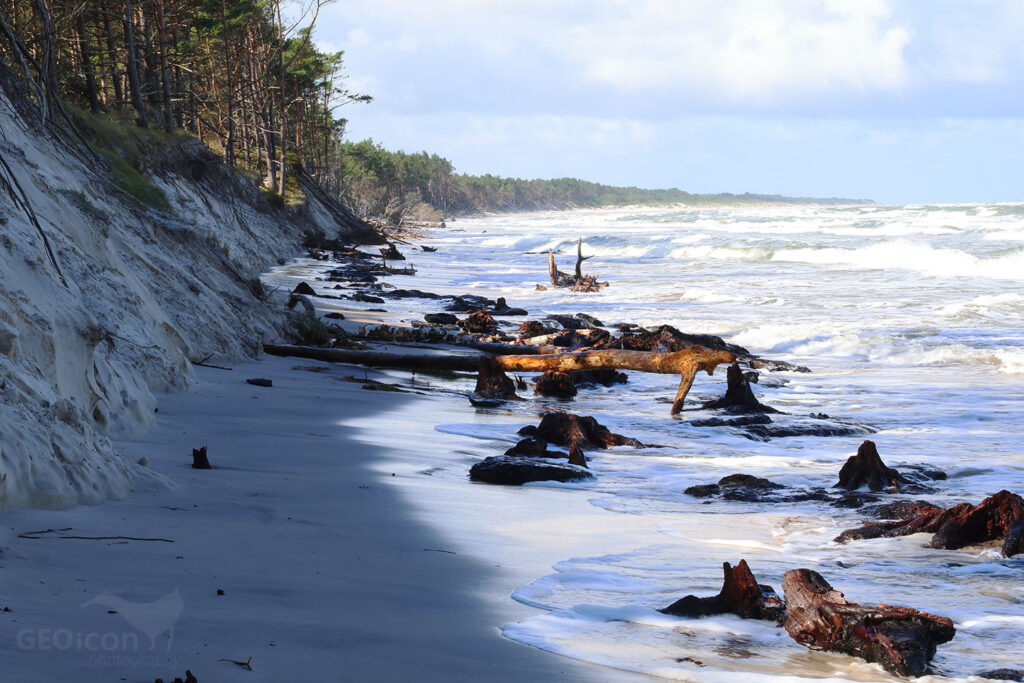
For many years, I have been embarking on photographic expeditions into nature—most often in search of avian treasures—across various corners of the globe. This past September was no exception. Taking advantage of the beautiful “Indian summer” weather, I headed north. There were four photographers in total, with an ideal average age of 33. In short: our entire family!

Great black-backed gtull on a trash can in Gdańsk.

A Grey heron on the fence of the zoological garden in Gdańsk.
Polish drivers have a poor reputation among their Czech counterparts—both based on experiences abroad and on roads within the Czech Republic itself. Nevertheless, we set out on a long journey by car. As we traveled along Polish roads, we developed a working hypothesis: Polish drivers are, without a doubt, playing a sort of game. They compete to see who can overtake the most Czech cars while committing the most serious traffic violations possible. A special bonus is awarded if the maneuver puts their own life—as well as the lives of other road users—at risk. Naturally, this bonus increases in value depending on the age of the vehicle and its technical limitations (or lack thereof).
As the kilometers ticked by, we became increasingly convinced of this hypothesis. Overtaking on the right on the highway, crossing double solid lines in areas with poor visibility, and failing to maintain a safe following distance—these were our daily experiences.

A Great cormorant on a lake in Słowiński National Park keeps an eye on fishing nets.
It is clear that if a nature photographer has three fierce competitors—all eager to capture the best possible shot, as close-up as they can, and faster than anyone else—breathing down their neck (or even looming well ahead of them), they must adapt their photography strategy and tactics accordingly. This time around, our team opted for a very specific niche: urban wildlife photography. And I must say, it paid off.

Sometimes, a bit of “real” wildlife crosses the path of an urban wildlife photographer. An adult Dunlin on a beach in Słowiński National Park.
The very term “urban wildlife photography” explains it all. It involves photographing wild animals—creatures living freely, not under human care—that are found in our immediate vicinity. Because they are accustomed to human presence, their “flight distance”—the distance at which they will flee—is relatively short, sometimes even close to zero. This suited our family photography team perfectly.

A juvenile Dunlin in Słowiński National Park.
Despite the madness we experienced and the suicidal maneuvers we witnessed on Polish roads, we arrived in Warsaw safe and sound. It is a beautiful city, full of parks and endless, well-maintained embankments along the picturesque Vistula River. We also encountered our first examples of urban wildlife: great cormorants, herring gulls, hooded crows, and western jackdaws. Even more captivating, however, was our walk through Warsaw at night and our ascent to the city’s tallest building—the Varso Tower.

“Stalin’s Penis”—a structure from the socialist era that took the renowned Lomonosov University in Moscow as its model.

A view from the highest accessible observation deck of the Varso Tower. From here, the monumental socialist symbol appears as a tiny, cowering object.
Even in early childhood, I was deeply impressed by the historical drama „The Valley of the Bees“, directed by František Vláčil. Some of its scenes were filmed at Malbork—the largest brick castle in the world. We simply couldn’t pass up the chance to visit. Beyond the castle’s staggering size, we were also able to indulge our passion for urban wildlife—even urban macro wildlife.


In Polish cities, Jackdaws have everything somewhat under control. Even in Malbork.
Our next base was the ancient city of Elbląg (pronounced Elblog), founded by the Teutonic Knights as early as the 13th century. The historic center and the beautifully landscaped embankment of the river—also called the Elbląg—are dominated by St. Nicholas Cathedral, with its 97-meter-tall tower. Not far away lies the mouth of the Vistula River. On its right bank are the renowned beaches of Mikoszewo and Jantar. And as the name of the latter suggests, this is a beach where the vast majority of Polish amber is found.

The picturesque town of Elbląg, featuring a river of the same name and the nearly 100-meter-tall tower of St. Nicholas Cathedral—which was visited by Pope John Paul II.

A Wood pigeon performed its morning grooming on the balcony opposite every day.

Every evening, before flying off to their roost, the hooded crows would once again inspect the local antennas and chimneys.

A pair of Common kestrels managed to spend every night on a narrow ledge of the cathedral tower, even amidst the full glare of the architectural lighting.

Great cormorants on sandbanks at the mouth of the Vistula River. In the background, on the horizon, are harbor cranes in Gdańsk.
The small yet sprawling town of Łeba—devoid of high-rise buildings and featuring a modest harbor—lies right next to Słowiński National Park and served as another base for us during our journey along the Baltic coast. We were particularly looking forward to the national park; however, the paths accessible to the average visitor are few and far between, leaving one with almost no view of the park itself. As for the museum of Cold War-era rockets, that held no appeal for us. Consequently, the most compelling attraction remains the coastline, with its “stone forest” and beaches—stretches of land being gradually swallowed up, step by step, by the endless succession of sea waves pounding against the shore.

A beach in Słowiński National Park. The constant surf gradually eats away at the coastal pine forest and the sandy shore. Where now only blackened roots remain, there once stood a forest.
Although I am not particularly fond of visiting cities, I absolutely love exploring the ports of Gdańsk and Gdynia. Perhaps the timing—a visit in September, when the off-season crowds were manageable—played a part. The unique charm of the place certainly had an effect, too—that distinct port atmosphere, which feels so exotic to those of us from inland.

Herring gull in the foreground, a yacht in the background. Gdynia Harbor.

A young herring gull startled by an ocean-going yacht. Gdynia Harbor.

A male mallard in a wild flight near a pier in the port of Gdańsk.

A young white wagtail on a pier in the port of Gdańsk.
Międzyzdroje was our next and final stop in exploring the captivating Baltic coast. It is nicknamed the “Pearl of the Baltic” and is, in effect, the Polish seaside equivalent of Špindlerův Mlýn. One of its attractions is a long pier that stretches 300 meters out into the sea. This resort town is connected by a highway to Szczecin, Poland’s seventh-largest city. Right next door lies Wolin National Park; much of what applies to Słowiński National Park holds true here as well—though this location also features an enclosure where you can get a close-up look at European bison.

Black-headed gulls around a long pier in the town of Międzyzdroje.

A male House sparrow is evidently a local connoisseur. He is currently enjoying himself in one of the countless cafés in the town of Międzyzdroje.

Sunset with seagulls on the beach by the pier in the town of Międzyzdroje.
The Polish Baltic coast is beautiful. Although it is often claimed to remain undiscovered by tourists, that is no longer true today; even in September—outside the peak season—there are still plenty of people around. Nevertheless, it is still possible to find spots that see very few visitors, thanks to the vast extent of the local protected areas. And the fact that people cannot significantly disturb nature here is, in truth, a very good thing.

An ornithological curiosity: a partially leucistic specimen of the Western Jackdaw in the port of Gdańsk.